It didn't start today. It started 30 years ago.
Who is writing this blog: 30 years of datacenters, virtualization and clouds — and now private AI supercomputers, built hands-on. An introduction.
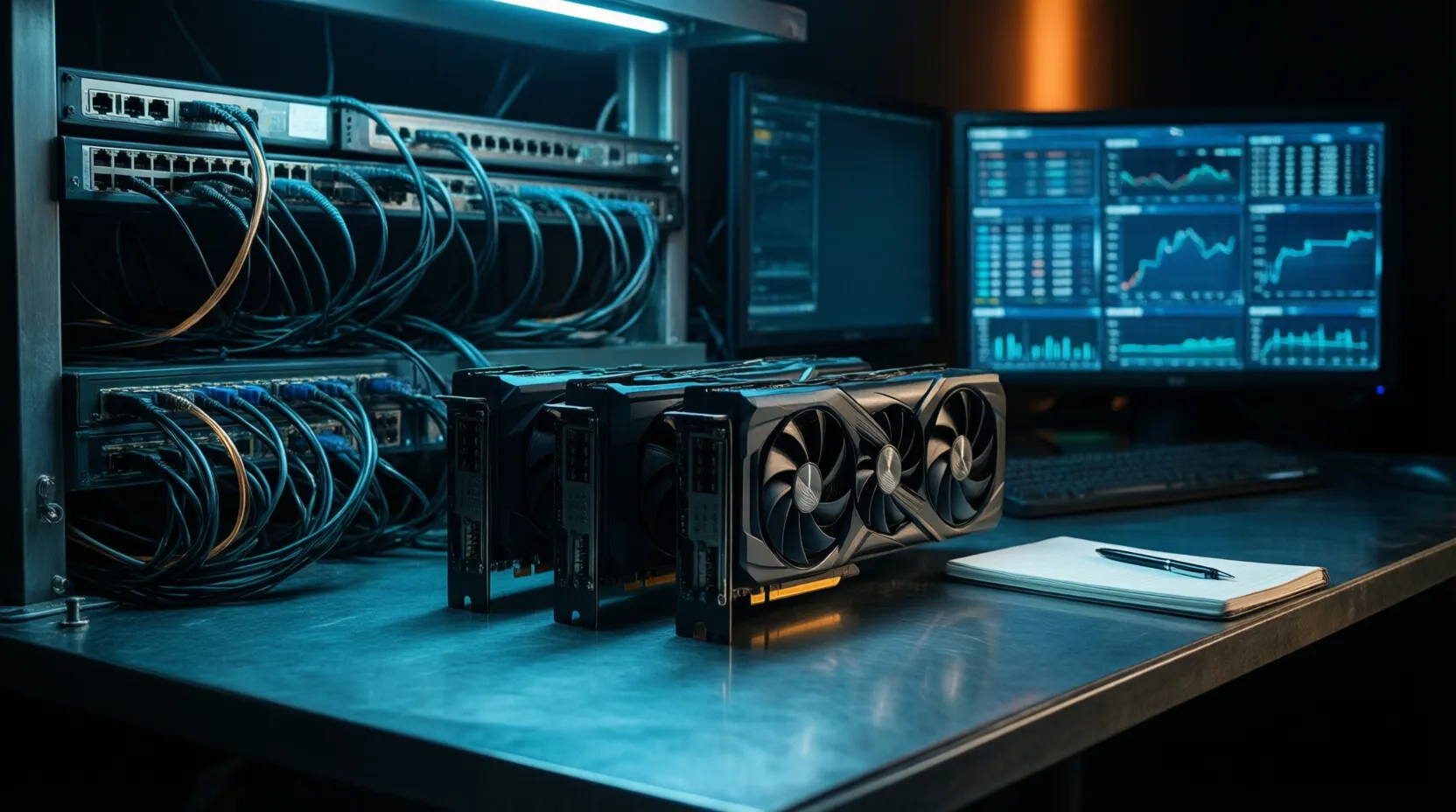
Everything you see on this blog is cooked in-house — including this picture. It was generated on one of my own RTX 3090s, offline, in under two minutes. Full recipe below.
Feature image made in my lab — image model, prompt and settings
- Image model
Qwen-Image 2512— fp8 (e4m3fn) variant. The bf16 pair does not fit a 24 GB card; fp8 weights are stored compressed and cast at compute time- Text encoder
Qwen2.5-VL 7B— a vision-language model doing the prompt understanding, which is most of why the composition follows a long prompt- Generated on
- 1× NVIDIA RTX 3090 (24 GB) in my own lab, through a self-hosted ComfyUI — on my hardware, my electricity, nothing leaving the building
- Settings
- 1664×928 · 20 steps · cfg 2.5 · euler / simple · shift 3.1 · seed 1992 · ~116 s
- Prompt
- an open workstation on a metal test bench with four high-end graphics cards mounted in a row, network switches and neat patch cabling on the left, live monitoring dashboards glowing on screens to the right, a paper notebook and pen on the desk, moody editorial hardware photography, cold blue and cyan light with a single warm amber accent, shallow depth of field, 50mm, dark background, fine detail, cinematic, high dynamic range, no text
- Negative prompt
- text, words, letters, watermark, logo, signature, caption, ui, people, faces, hands, cartoon, illustration, cgi render, oversaturated, blurry, low quality, jpeg artifacts
- Licence
- Apache-2.0 — both the image model and the text encoder. Commercial use permitted with no use-based restrictions, which is exactly why this stack and not a prettier one
Welcome. I am Attila Macskásy — a Hungarian infrastructure engineer and cloud architect, and for the past year, a man with a server room’s worth of GPUs humming at home.
This blog is about private AI: running serious AI models on hardware you own. Not API calls to somebody else’s datacenter — your GPUs, your network, your electricity bill, your data. I build this stuff with my own hands, I measure everything, and I write down what actually happened, including the parts where I set money on fire.
Before the first teardown, some words about who’s writing. Credibility in this field is earned in decades, not in prompts — so here is where mine comes from. Each era below was, in hindsight, training for this one.
Why “private” AI
In September 2025 I wrote on cloudmigration.blog that I was building a cost-effective edge AI supercomputer, and I gave the reason then that still drives everything here:
Running AI offline provides both privacy and independence. Even if you pay for cloud AI services, you’re never entirely sure how much of your prompts and data are retained. With my setup, nothing leaves my lab.
A year later that one desktop has grown into a small fleet, and the thesis has only hardened. I have since watched supposedly “local” inference stacks phone home from the serving process itself, measured what a single idle GPU really costs per day, and learned — twice, the hard way — what a 200-gigabit link does when a firmware bug decides you only deserve 13. All of that is coming as articles.
What to expect here
- Hardware builds, with invoices. What I bought, what it cost, what refused to POST, and the rules I derived from the tuition fees.
- Real measured numbers. Tokens per second, joules per token, watts at idle. Adjectives lose against tables.
- Big models on owned silicon. What it actually takes to serve 200B+ parameter open models on consumer GPUs and DGX-class unified memory — and where the limits genuinely are.
- AI coding agents, locally. Running agentic coders against my own models, and honest reports on where they shine and where they loop for two hours producing nothing.
- Failures included. The dead motherboards, the tripped breakers, the models that lock a node solid. That is where the learning lives.
My ambition is easy to state and hard to do: to be the most hands-on AI infrastructure engineer in Hungary — down to the silicon, seven days a week. I’m 46. I have the time, the energy, and (after some electrical work you’ll read about soon) the amperage. This blog is where I prove it or fail in public.
cloudmigration.blog stays alive, but its mission has quietly inverted: for years it was about moving into the cloud; now it is about moving out — deliberate cloud exit, under its new banner cloudexit.blog. The reasoning is the same one behind this blog: self-hosted, on-premises alternatives to hyperscalers that may not respect your privacy — and renting AI models is not getting cheaper. Its about page still has the longer version of my story. privateai.blog is where the AI work lives from now on.
If any of this is your world too — say hello on LinkedIn.